France Is Building the World's Most Expensive Road
Réunion Island's €2B Mega-Road Faces Volcanoes, Lawsuits, and a 2030 Deadline
At just 12.5 kilometers long—and still unfinished—the project has already cost over two billion euros, making it one of the most expensive road constructions of its kind.
In a remote corner of France, an unfinished highway is quietly becoming one of the country's most complex infrastructure sagas, reports our website, citing Naked Science.
At first glance, the project seems straightforward: a new coastal road meant to connect two key settlements. In reality, it is far more complicated. The route includes the longest bridge ever built in France, stretches kilometers into the Indian Ocean, and has already cost billions of euros.
Yet years after construction began, a significant portion of the road remains incomplete. The reason lies in its location—not in mainland Europe, but nearly 9,000 kilometers away on the island of Réunion.
Situated east of Madagascar, Réunion is a volcanic island in the Indian Ocean. Despite its remoteness and tropical climate, it is an integral part of France. Under the Constitution of the Fifth Republic, the country is considered indivisible, meaning its overseas territories are governed the same way as the mainland and represented in the national parliament. This status has consequences: the Nouvelle Route du Littoral (New Coastal Road) is not just a regional upgrade but one of France's largest infrastructure projects.
The new route is meant to replace the existing coastal road linking Saint-Denis—the island's administrative center—with the port city of Le Port.
Built in 1959, the old road runs along a narrow strip between the ocean and sheer volcanic cliffs. Every day, some 80,000 vehicles travel along it, making it one of the island's most vital transport arteries—and one of its most dangerous.
Réunion lies in a cyclone-prone zone. Powerful storms bring winds exceeding 200 kilometers per hour and unleash waves that crash directly onto the road. Meanwhile, the cliffs above suffer from rain and heat, causing rocks—and sometimes entire sections of the slope—to collapse onto the road below.
Engineers faced a fundamental challenge: expanding or reinforcing the existing route without exposing it to the same risks was impossible. The only solution was to move the road farther from the cliffs.
Initially, the plan involved a combination of offshore embankments and a tunnel near Saint-Denis. However, geological surveys revealed that the volcanic rock was too fractured and unstable for large-scale tunneling, making the project excessively complex and costly.
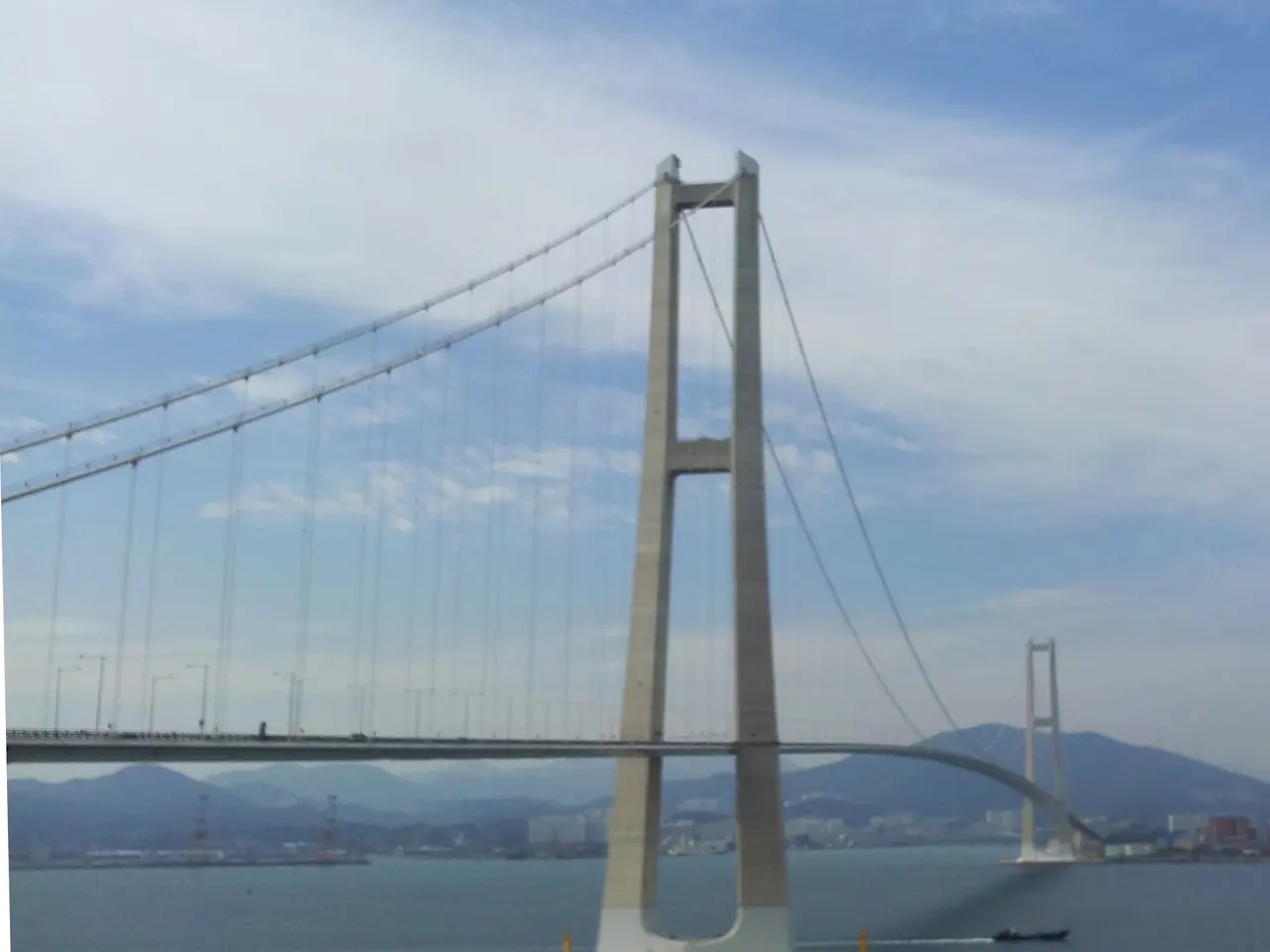
In 2011, a new plan was approved. Instead of a tunnel, officials decided to build the road primarily over the sea, combining massive embankments with a long viaduct running parallel to the coast. The centerpiece of the project became the Grand-Chaloupe Viaduct, stretching 5.4 kilometers in length and reaching up to 300 meters from the shore. Upon its completion in 2017, it became the longest bridge in France.
Its construction required techniques more commonly associated with offshore energy projects than roadbuilding. Two concrete plants were built on the island to produce structural components. The bridge itself was designed as a box-girder structure, with hollow concrete segments connected by high-tensile steel cables.
These segments rest on 48 supports, each engineered to withstand powerful ocean waves while minimizing resistance to currents. Installing them became a major operation in its own right. A specialized barge, the Zourite—comparable in size to a football field and equipped with lifting mechanisms and extendable legs to anchor it to the seabed—was brought in from Europe.
From this platform, workers positioned the massive concrete bases, each weighing around 4,500 tons, with centimeter precision. First, they secured the foundations to the seabed, then constructed the upper sections of the supports. Building all 48 supports took four years. Afterward, using a launching girder, they assembled the bridge deck, installing the segments in pairs to maintain structural balance.
While the viaduct proved to be the most technically complex element, the embankments became the project's biggest challenge. Rather than resisting the sea, they were designed to absorb its energy. Built up from the seabed, they are protected by layers of rock and concrete blocks. The outer layer consists of large interlocking elements—acropodes—which dissipate wave energy, while beneath them lie layers of smaller stones to dampen residual vibrations.
The concept itself is well-established in coastal engineering. The issue on Réunion was scale.
Initially, the project was expected to require around seven million cubic meters of stone, prompting plans to open new quarries. But these proposals faced strong opposition from local residents and environmentalists, who warned that extraction would threaten ecosystems, generate noise, and create dust. Réunion is renowned for its biodiversity, home to coral reefs, rich marine life, and protected natural areas.
In 2018, a court banned quarry development due to risks to endangered species. Without a reliable source of materials, construction ground to a halt.
Meanwhile, costs soared. With the 12.5-kilometer route still unfinished, the price tag had already exceeded two billion euros, making it one of the most expensive road projects of its kind.
The troubles continued. In 2021, it was discovered that hundreds of acropodes had been installed incorrectly, requiring costly corrections. Facing delays and escalating expenses, authorities decided to change their approach.
In 2022, officials decided to complete the remaining section not as an embankment but as an extension of the viaduct—effectively converting even more of the route into a bridge. While technically feasible, this approach would drive up costs by hundreds of millions of euros.
The shift also introduces new logistical hurdles. The barge used in the viaduct's construction had already been returned to Europe in 2017, meaning similar equipment will now have to be sourced anew.
Preparatory work on the final segment began in late 2025, with major construction slated to start in 2027. The project is expected to wrap up by 2030.
For now, the Nouvelle Route du Littoral remains unfinished. Some sections are already open, but drivers still must detour onto the old, hazardous road to navigate the missing stretch—the very danger the project was meant to eliminate. The situation underscores the challenges of building large-scale infrastructure in remote, ecologically fragile regions.
Réunion has a track record of executing complex engineering projects despite its isolation. Yet the new coastal road demonstrates that even with substantial resources and political backing, geography can still dictate the pace—and the outcome—of construction.
Read also:
- India's Agriculture Minister Reviews Sector Progress Amid Heavy Rains, Crop Areas Up
- Cyprus, Kuwait Strengthen Strategic Partnership with Upcoming Ministerial Meeting
- Inspired & Paddy Power Extend Virtual Sports Partnership for UK & Ireland Retail
- South West & South East England: Check & Object to Lorry Operator Licensing Now