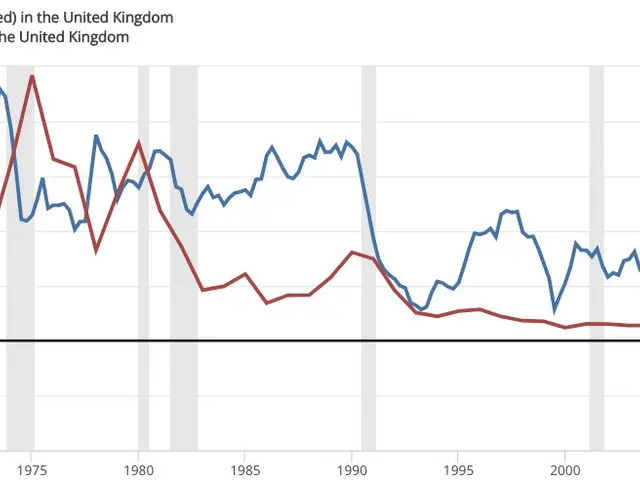
Sovereign risk is influenced by a country's financial assets and debts.
In Singapore, around one-fifth of its government expenditure is funded through investment returns from its sovereign funds [1]. These funds, estimated to amount to three to four times Singapore's annual GDP, surpass the size of the sovereign funds of several resource-rich countries [2].
The average annual (non-tax) income generated by these funds over the past five years amounts to 7% of the country's GDP [1]. Half of the expected long-term real returns from these funds are reinvested to strengthen long-term financial stability [3]. The remaining half can be utilized for government expenditure, an amount nearly equal to Singapore's corporate tax receipts [4].
The management of these funds has been key to Singapore's fiscal success. Over the past 60 years, the country has managed one of the world's largest sovereign portfolios, including assets managed by Temasek, GIC, and the Monetary Authority of Singapore [5].
The focus on better managing the public balance sheet and the level of net worth is crucial for ensuring sustainable prosperity [2]. A key finding of a study on developed country capital markets is that government net worth (assets minus liabilities) is a more important fiscal factor for sovereign creditworthiness than the gross debt-to-GDP ratio [6]. This insight challenges the conventional focus in public finance on debt and deficit levels alone.
Financial markets and rating agencies recognize that liabilities matter less if they are backed by high-value assets holdings, as in Singapore [7]. Governments with stronger net worth recover faster from recessions and have lower borrowing costs [8]. An International Monetary Fund working paper suggests that a net worth anchor encourages public investment and economic growth [9].
Demonstrating diverse revenue streams, including both tax and non-tax sources, can reduce a government's risk profile [10]. In Singapore's case, the diverse revenue streams from its sovereign funds have contributed to its triple-A rating, despite a higher gross government debt-to-GDP ratio than many developed economies [11].
Extensive portfolios of commercial assets, including real estate and state-owned enterprises, are often undervalued in the official accounts of governments [12]. Undervaluing commercial assets in official accounts may worsen economic challenges and obscure the opportunity costs of poor asset management. Real estate alone is estimated to have a total value equivalent to global GDP [13]. Global public assets are estimated to be three times the value of global GDP, with half consisting of commercial assets like real estate and corporate holdings [14].
Good governance, strict fiscal discipline, and effective balance sheet management can enhance a country's fiscal and economic position, even for those lacking natural resources [15]. The net worth target is relevant to the reform of fiscal frameworks, such as the euro area's framework, to allow for public investment in a high-debt environment [2]. Policy-makers should consider adopting net worth-driven financial decision-making and oversight to create greater fiscal space and achieve strategic objectives.
- To strengthen long-term financial stability, half of the expected long-term real returns from Singapore's sovereign funds are reinvested.
- The management of Singapore's sovereign funds, including assets managed by Temasek, GIC, and the Monetary Authority of Singapore, has been key to its fiscal success.
- The focus on better managing the public balance sheet and the level of net worth is crucial for ensuring sustainable prosperity in Singapore.
- Demonstrating diverse revenue streams, including Singapore's income from its sovereign funds, can reduce a government's risk profile.
- Governments with stronger net worth, like Singapore, recover faster from recessions and have lower borrowing costs.
- An International Monetary Fund working paper suggests that a net worth anchor encourages public investment and economic growth in countries like Singapore.
- Policy-makers should consider adopting net worth-driven financial decision-making and oversight to create greater fiscal space and achieve strategic objectives, following the example of Singapore.