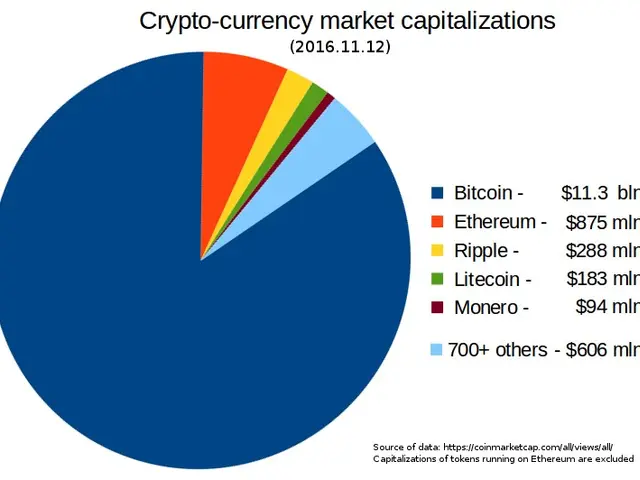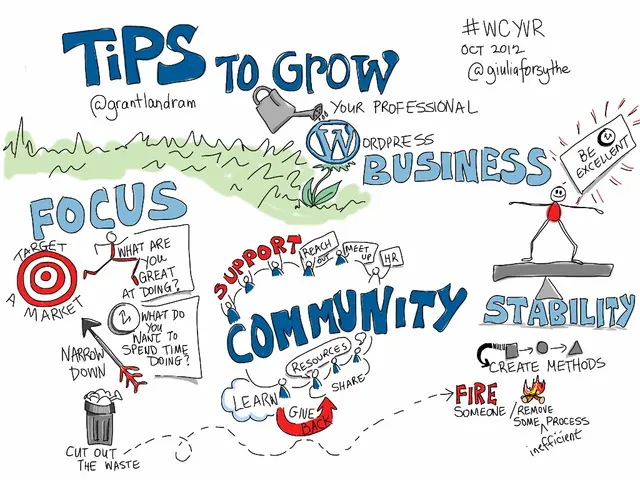
A collection of 20 diverse business infographics, available in editable formats, for your convenience.
In the digital age, infographics have become a powerful tool for businesses, serving as a visual bridge between complex data and easy-to-understand information.
Infographics can create a simple timeline or map for readers to follow, making it easier to digest and process information. They can also include labels that explain why a section is highlighted when the significance may not be obvious to readers.
The versatility of infographics is evident in their ability to be customized for any kind of data in presentations, whether made in PowerPoint or another platform. Numbers can make it clear that there is a specific order to follow in lists and processes, reducing potential confusion for readers. They can help differentiate between points and guide readers' eyes to where the infographic creator wants them to look, using directional cues like arrows and lines.
Effective strategies for creating and utilizing business infographics across various purposes include first defining your purpose and audience, then applying clear design principles such as visual hierarchy, consistency in color scheme and fonts, and simplicity to avoid clutter. Tailoring the infographic type to the context—such as data visualization, how-to guides, timelines, or process flows—further enhances communication effectiveness.
For social media, use concise, visually engaging infographics like statistical or how-to types, with branded illustrations and percentage radials to capture attention quickly. Guest posting benefits from infographics that clarify complex data or processes succinctly, complementing the guest article and making the post more shareable.
On sales pages, infographics can address customer pain points by visually guiding users through solutions or benefits, often using step-by-step or how-to formats combined with clear calls to action. For data visualization, use charts, graphs, and icons designed with clarity and accuracy, emphasizing key trends or comparisons to make large datasets accessible and compelling for decision-making.
Regarding internal processes and communications, infographics simplify complex workflows and campaign results, helping teams identify bottlenecks and align on goals more effectively than text-heavy reports. They improve engagement and ensure consistent understanding across departments. In PowerPoint presentations, infographics serve as visual summaries or explanatory aids, organized with clear headers, whitespace, and a logical flow to guide the audience’s attention seamlessly.
Key design tips include grouping similar data visually, using numbered labels for steps, avoiding information overload, and ensuring every visual element adds meaning rather than decoration. Typography should create a hierarchy so viewers quickly grasp primary versus supporting information. Consistent brand-aligned colors and fonts strengthen recognition and professionalism.
Infographics can be used for a variety of purposes beyond traditional data representation. They can be used to set goals or assign responsibilities to different members of a team. Business infographics can also be used for internal communications, such as setting guidelines or communicating the Diversity and Inclusion code of conduct.
With numerous resources available, creating and marketing business infographics has become easier than ever. Templates, articles on creating process infographics, marketing infographics, comparison infographics, leadership infographics, consulting proposal templates, consulting report templates, case study infographics, and more, can be found online.
In summary, effective business infographics are strategically chosen by type and customized for the audience’s needs, emphasizing clarity, visual appeal, and purposeful design, making them versatile tools for social media, guest posts, sales pages, data insights, internal workflows, communication, and presentations.
- To enhance business communication, an infographic maker can be used to create infographics that visualize complex finance data in a lifestyle context, thereby enabling easy data visualization and improved understanding.
- In the realm of technology, business infographics can be utilized to present data visualization in a business context, such as process flows or how-to guides, serving as valuable assets for pitching ideas, explaining processes, or showcasing results efficiently.
- Optimized for social media engagement, infographics can effectively represent statistical data or guide readers through lifestyle tips, incorporating branded illustrations and percentage radials to catch the eye and encourage sharing.